

Here’s everything you need to know about the world of television for Thursday, April 16th, 2026:
THE STREAMING INDUSTRY APPARENTLY DOESN'T UNDERSTAND THE WORD 'TRANSPARENT'
Late Thursday afternoon, Netflix released its first quarter earnings numbers to investors and the press and I am not going to rehash them here, because there are plenty of places where you can read those hot takes.
But while the public will hear a lot of data points being tossed around by company executives touting viewing numbers with little or no context, and Wall Street analysts parsing the earnings numbers, very little of that will really tell you how well the company is actually executing its strategy.
Netflix no longer reports detailed membership growth metrics, a decision which doesn't bother me too much in the abstract. Netflix - and increasingly, other rivals - argue that a focus on raw subscriber numbers provides the wrong incentive for streamers. Not all subscribers are the same and as one Netflix executive told me, 200,000 subscribers from a country with a high ARPU (average revenue per user), can be worth more than 2,000,000 subscribers with a low ARPU and a high churn rate. So focusing just on subscriber growth can be misleading.
But if Netflix isn't providing overall subscriber numbers - much less numbers broken out by region - and is also providing less information on regional ARPU numbers, how does anyone judge the strategic success of the company? Sure, we have the overall revenue numbers, free cash flow, earnings per share and the other top line numbers. But how do we judge what's under the hood of the company?
I apologize in advance to some of you, because this is an extremely abbreviated explanation and I know I am glossing over many important things. But this is not a novella.
In the old broadcast and cable world, making money and determining value was complicated, but the general outlines were easy enough to be understood by most civilians. You produce some programming, and hopefully it draws enough viewers to allow the network to sell enough ads at a price where there's a profit. And yes, there was network branding that played into that as well as things such as carriage subscription fees once cable television rolled out. But because viewers could turn the channel whenever they wanted, the primary driver for any network was to get as many eyeballs at any one particular time as possible. That is how you made money. And it was fairly easy to track these metrics from outside the company.
SVODs such as Netflix have a business model that couldn't be more different. Because viewers have to make the conscious decision to subscribe (and to keep subscribing), the economic factors that matter the most are the ones that revolve around the cost of finding the subscribers and keeping them happy enough to pay up every month. Simple viewing numbers don't provide much clarity on those two important metrics. So the focus is on something called "customer lifetime value."
You figure out your customer acquisition cost (CAC) - or what you have to spend for each person who subscribes - and measure that against the customer lifetime value and you have a pretty good metric to use to help determine how much you should be spending on everything from salaries and marketing to content production and overhead.
Simply put, the customer lifetime value is the total worth of each customer throughout the life of your relationship with them. That includes all sorts of data points, ranging from how long each subscriber is likely to stay before churning off, the price they're paying each month, etc. If you can accurately figure that out, you can compare the customer acquisition costs to the customer lifetime value and use that to help you predict a wide variety of future business decisions.
It's not just whether or not you'll be profitable, but it helps you to make all sorts of related strategic decisions. If accurate, it gives you a bird’s-eye view of your marketing expenses, efforts, campaigns, and strategies. You can use it to balance short and long-term financial goals. You can figure out which spending is bringing the best return and where to focus future efforts.
It can also help you identify high-value customers. In the case of SVODs, that means customers who are likely to stay subscribed for a long period of time.
The related side of this is that you can also determine which decisions might help that overall customer lifetime value. Increasing that CLV at a rate lower than you are increasing spending is basically increasing your revenue stream and your profits.
When applied correctly, that CLV number can be used to help determine what content is most valuable to the bottom line. For instance, a show that draws in an above-average number of new subscribers (which lowers customer acquisition costs) would have more value to a streamer than another series that generates five times the views, but many fewer new subscribers. And as you can imagine, there are all sorts of variations of this equation.
Each streaming company has a different series of data points it tracks and none of the approaches seem to be compatible with each other. Streaming services can't even agree on what qualifies as a "view," much less come to a consensus on what CLV looks like in a streaming-forward world.
And the problem is exacerbated at some of companies (Paramount Skydance, I'm looking at you), when the decision is made to tweak the equations in order to justify business decisions you've already decided to make.
In the abstract, CLV is determined by this equation:
Customer Lifetime Value (CLV) = (ARPA × Gross Margin)÷ Churn Rate
In other words, you estimate the average revenue per account by the gross margin and divide by the estimated subscriber churn percentage each month.
But while that formula sounds straightforward enough, if you are wrong in any assumption, your bottom line can quickly go sideways.
And the problem with trying to determine the success of any streamer - Netflix included - is that we don't know any of those numbers. Netflix may be profitable, but there is no real way to know the specifics of why from outside the company. Netflix executives tout a bunch of viewing numbers for some of their hit titles during the earnings call, and that's all well and good. But viewing numbers don't tell is anything about the financial success or failure of a specific title, much less the entire company. They are just a bunch of interesting factoids, delivered without context.
One thing we can watch for during the earnings call are the topics executives brush off or don't want to discuss in detail. Those items are likely the ones in which the company is less happy with its success. Then journalists and analysts have to figure out why those topics were important to downplay and what that says about the company.
I don't expect Netflix or any streamer to open their books and provide all the relevant financial metrics they have available internally. I do wish they would be transparent enough to deliver the minimum data points we need to accurately judge the success of the company's strategy and its financial health.
SPEAKING OF NETFLIX
The streamer announced today that co-founder Reed Hastings is leaving the company after 29 years. He's stepping down as Chairman of the Board in June and is expected to focus on philanthropy and other pursuits.
There aren't many executives I consider to be true visionaries, but Hastings fits the bill. I first spoke with him in 1999, when I was working at a now long-defunct financial news website. As that point, Netflix was a DVD distribution company with one warehouse in the Bay Area. We talked about that business, but when I asked him about the future and where he saw the company headed, he began talking about an idea he admitted sounded "a bit out there."
"Imagine instead of renting the DVD of a movie, you could turn on your computer and it would be delivered to you over the internet. A vast catalog of titles, available on demand. Eventually you'll be able to watch them on a big monitor or even your television screen. You would have an entire video store available to you with just a few clicks of your keyboard. That's the business I want us to eventually be in."
He said this at a time when nearly all internet connections in the United States were dial-up speed. And no one had a sense of how quickly high-speed broadband would be available to the average household.
I'll admit that when he told me that, I secretly wondered if he was nuts. But that is an example of the type of vision that was necessary to make Netflix the equivalent of a utility for many of its customers.
I HAD SOME THOUGHTS ABOUT PETE HEGSETH AND THE MEDIA
I have tried very hard to write about Department Of Defense/War Secretary Pete Hegseth and his relationship with the media. But his attack today, which included comparing the press to the Pharisees mocking Jesus Christ at the Temple was so odd and unhinged that I decided to vent a bit:
It's not a surprise that Pete Hegseth and his Scooby Gang of staffers have made it their mission to punish the press as much as possible. The press is an easy target and it's especially fun because reporters covering the Defense Department are not going to directly confront misinformation. So Pete Hegseth feels all brave and badass standing in front of the press corp and calling them traitors. Because he knows they won't talk back.
But that bluster is there to hide the underlying core truth of Pete Hegseth. Deep down inside, he's a scared little boy who is intimidated by the people around him. He walks through life petrified people are going to see the man that's hiding behind the outrage: someone who is in over his head, who doesn't feel worthy of being the head of the Defense Department. And perhaps most importantly, he knows he's not really the brave soldier of war he pretends to be. He's not worthy of his position and he lives every day feeling that truth deep inside his soul.
If Pete Hegseth were half the warrior he pretends to be, he would sit down with experienced reporters and directly answer their questions without deflecting. He would be confident in knowing that he knows what he's talking about and if the reporter is lying or being inaccurate, he can prove them wrong in real time.
ODDS AND SODS
* That Tubi App For ChatGPT doesn't work the way you think it does.
* Law & Order: SVU has been renewed at NBC for season 28. And Law & Order: Organized Crime has been cancelled after five seasons on NBC & Peacock.
* Brian Williams is set to host an original podcast interview show for Netflix entitled We're Back! With Brian Williams.
* ITV's Iong-running 7 Up documentary series that began in 1964 following 10 boys and four girls at age 7 is concluding with a final installment later this year entitled 70 Up.
* Peacock has canceled The Copenhagen Test after one season.
* QVC Group, the parent company the home shopping TV brands HSN and QVC, has announced it will file for Chapter 11 bankruptcy protection.
* The eighth and final season of All-American will begin with a two-hour premiere episode Monday, June 22nd on The CW.
* The stand-up special Josh Johnson: Symphony will premiere Friday, May 22nd on HBO.
* Season four of Sky Meds premieres Thursday, May 21st on Paramount+.
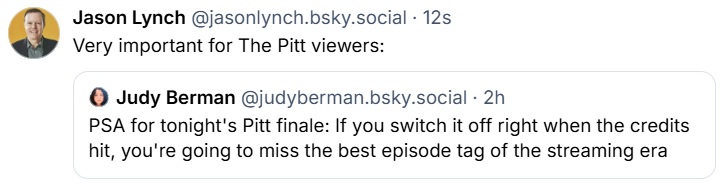
TWEET OF THE DAY
WHAT'S COMING TONIGHT AND TOMORROW
WEDNESDAY, APRIL 15TH, 2026:
* American Detective With Lt. Joe Kenda Season Premiere (Investigation Discovery)
* Balls Up (Prime Video) - (first look video)
* Divorced Sistas (Paramount+)
* Fake Profile (Netflix)
* Love Island: Beyond The Villa (Netflix)
* Margo's Got Money Problems Series Premiere (Apple TV)
* Made With Love (Netflix)
* Masterchef Season Sixteen Premiere (Fox)
* Million Dollar Secret Season Premiere (Netflix)
* Nova: Return To The Moon (PBS)
* One Day In My Body Series Premiere (TLC)
* On The Case With Paula Zahn Season Premiere (Investigation Discovery)
* Somebody Has To Know Series Premiere (Netflix)
* The Law According To Lidia Poët (Netflix)
* Toaster (Netflix)
THURSDAY, APRIL 16TH:
* Beef Season Two Premiere (Netflix)
* Big Mood (Tubi)
* Dandelion Series Premiere (Netflix)
* Jerry West: The Logo (Prime Video)
* Ronaldinho: The One And Only (Netflix)
* Silent Witness Season Twenty Nine Premiere (BritBox)
* Vanderpump Villa Season Premiere (Hulu)
SEE YOU FRIDAY!