
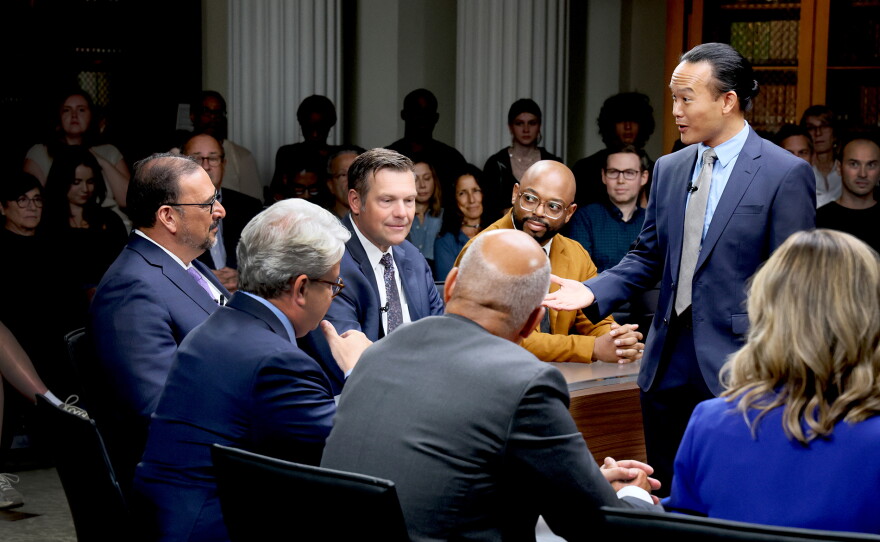
The PBS series Breaking The Deadlock has a very straight-forward premise. Bring together a politically diverse group of people who have agreed to be part of a conversation without knowing the identity of the other participants or the topic of the conversation. Then the moderator (in this case, Aaron Tang) provides a fictionalized premise based on a real-life problem. And he subtly guides the group through their discussion of how they would handle it.
It's a fascinating show and as you might imagine, it requires a great deal of preparation as well as the ability to pivot quickly as participants begin to weigh in.
The newest episode of the show focuses on election integrity and I recently spoke with Breaking The Deadlock moderator Aaron Tang about his process for putting the questions together and whether participating in the show has made him more or less optimistic about the future of the United States.
The conversation has been lightly edited for clarity (mostly mine)
Once you know the topic of an episode, what does the process look like for you? How do you figure out how the conversation is going to flow and what you are going to say?
Aaron Tang: It starts, honestly, it starts with a writer's room.
I was just doing one for the next episode with a team of about eight people, a writer, myself, and five or six producers. And we start with a broad theme. So that past episode was obviously America's 250th birthday, founding principles, how do we keep them relevant?
And then you just start throwing ideas against the wall. Different dilemmas that could happen that are plausible, rhyme with reality today, that could implicate that theme. And we just sort of workshop a draft of a scenario.
It starts with six or seven chapters. So in this chapter, we're going to explore just a basic question about troops, what happens if troops come in the city. And then we've got to flesh it out. So you're just throwing ideas against the wall, picking general dilemmas. And then over time, it gets refined. We do casting, we figure out that who will actually be there, and then we can make the dilemmas more specific.
You don't know how they are going to answer the questions. It's spontaneous, you can't predict where the conversation is headed. So as the episode unfolds, how closely can you hue to what you've got planned out?
Aaron Tang: So you're absolutely right. I would say, it's an iterative process. So when we first sit down with a rough draft, a very skeletal outline for how we'd like the dilemmas to proceed, two or three months before the show tapes, there's so much we can't anticipate.
But as we get closer, as we get further along in drafting and casting, we start to see different ways that panelists could answer this question and would take us down a different path. We also have two rehearsals ahead of the taping.
And so I need to start gaming out in my head, if we go down this path, what are the hard dilemmas? How do we get back on track to make sure a future question is still available? So definitely there are curveballs, things that come out of left field when we tape. But if we've done our job right, both in the rehearsal and the drafting process, there'll be curveballs that we'll have at least been aware of in the back of our minds.
How much does the ultimate guest roster impact those questions or alter those questions as you're going through the process?
Aaron Tang: A huge amount. I mean, the panelists are the stars of the show. Their personal experiences and their viewpoints are exactly what we want viewers to take away.
I'm just a vehicle for the panelists. If we accomplish everything we want to accomplish at the end of a show, the viewer will see people who often disagree with each other on our panel, wrestling, listening to each other, talking to each other in a way where if we all did that with our neighbors, people who voted for the other guy in the last election, America would be a lot better off. It'd be a lot like the America maybe of the 80s and 90s when I was growing up where we had plenty of friends who were from different political parties and that was perfectly normal.
So I've got to let the panelists shine and the best way we can do that is to familiarize ourselves with who the panelists are, what are the real challenges they've gone through in real life, the positions they hold so we can put them in positions to talk to each other and really show the possibility of dialogue even if they disagree.
As you're guiding the conversation, as you are hearing the responses, you obviously have your own opinions about things. Sometimes they're saying things you don't agree with or perhaps things you know aren't accurate. So how are you able to navigate everything without allowing your ego and your own self worth to get in the way of the conversation?
Aaron Tang: First of all, I don't always succeed. Sometimes I can't help myself and I will make a mistake and I'll interject my own views and fortunately we can edit it out later on. But by and large, I see my role as making sure other people have a chance to respond. So if somebody said something that's controversial, maybe factually untrue, there will certainly be other people on the panel who can correct or make the correct point in response.
A lot of the questions though, are designed to emphasize the hard choices that people make. There is no right or wrong answer. It's not always that something is factually true or factually false.
If it's a question about whether or not somebody win the election in 2020 - that's an easy one. We try and put panelists in a gray area where there are hard values choices.
And when that's true, it's easier for me. Because there is no clear right answer in a lot of these situations. And that's a lesson for Americans to take away is that actually politicians on the right and the left like to oversimplify, make it look like my side is obviously right. The other side's lying to you or they're idiots. When in truth, the reason we disagree is because these are hard decisions.
The moderation job was a new role for you. What was the biggest challenge of taking it on?
Aaron Tang: Yeah, there were certainly a lot of challenges. One thing has been a challenge, but actually has been kind of fun for me. So it turns out what I'm doing in front of the panel is sort of creating a world for them, a sort of make-believe world that rhymes with reality so that panelists can inhabit roles and flex these muscles of difficult ethical decision-making.
And it turns out I have been doing that accidentally, unintentionally for the past 10 years. I'm a parent, I have a seven and a 10-year-old kid. And since my kids were little, I've played with them. We'll be down on the ground and when my 10-year-old boy was two or three he just loved fire trucks. And he'd say, "Can you make an emergency for me?" So he would have a fire truck and I'd create an imaginary fire. What does he do, right? How does he respond? What are his priorities?
Turns out that in a very micro scale, this is the same things that we're doing on the panel.
So inhabiting a simulated, a different world and putting people in that situation is a little bit like parenting. And so that is one insight that I think has been helpful to me to take on this new role.
Was it difficult to learn the TV skills? Because obviously you've got to think about where the cameras are, what else is going on in the room. There is a lot of stuff happening on the process side of the show aside from the conversation.
Aaron Tang: Yeah, that is hard. I did have an acting coach before the first episode who was helpful.
I wear an ear wig and the producer can tell me if I'm blocking a camera. If I need to move, I can move. So I'd certainly have had help along the way, but one of the things that the acting coach said to me, which was so helpful, is the worst actors, the worst kind of acting is somebody who's consciously thinking that they're acting. So my kind of approach when I'm out there talking is that I don't even think that I'm on TV.
I'm just curious what people say. I'm looking around to draw different panelists into the conversation. In that sense, it's actually not that different from being in a law school class, teaching a law class where you're asking hard questions, sort of the Socratic method to students.
So maybe that's some good training as well. But I don't think of it as really camera skills.
I think I'd be a terrible actor if I was doing actual TV acting.
Do you like looking at yourself afterwards when the program's completed?
Aaron Tang: I don't like looking at myself.
I like thinking, I like hearing the conversation and replaying in my head, Oh, I wonder what I could have done better, what questions I could have asked, or who I could have drawn in. So I think there is a nice learning process that happens from watching the episodes afterwards, but it doesn't bring me any real joy to see myself on the screen. No joy and no stress.
Honestly, I'm just trying to get kids to bed and get kids to school on time. Most of the time, all those other things are so far from my priority list.
So how do you juggle all these things. This job, your family, your school work. How do you fit all of this into your life?
Aaron Tang: I think a lot of it is the things that I don't do. I don't watch TV. I'm not on social media. I'm not you know, I have a pretty limited set of things that I like to focus on with my family and my work. So that's helpful removing distractions.
But ultimately, I think the best answer I can give is this is really fun. It's really fun. And it's it feels valuable and important modeling these kinds of conversations for viewers. And when you're doing something that is fun and feels important, it's easy to be efficient because your heart is in it. You're you know, it doesn't feel like work.
So how do I do it? You know, there are no shortcuts. I think for a whole week up until we're taping, I'm holed up in a hotel room rehearsing, practicing, just talking to myself, imagining what if he says this? What am I going to say back? So there's 100 hours in the week that leads up to it where I'm just in my own brain working through it. There's no shortcuts, but it doesn't feel like work. It's fun.
So are you sleeping the night before?
Aaron Tang: Not the first episode when we taped the pilot, two or three years ago. Nowadays, it's less anxiety inducing. We've done it so many times. I sleep pretty well the night before now.
What's the reaction been from colleagues who've seen this?
Aaron Tang: I think positive. You know, it is a little bit off the beaten path for a law professor. It is not a lot different than my job. A lot of the questions that we ask are policy, moral, ethical questions rather than strictly legal questions.
So, we don't have an opportunity to engage in sort of high level constitutional theory type conversations. But, they're all very prominent, proximate, timely American democracy issues, live problems facing our society. So in that sense, I've had a lot of promising, helpful conversations with colleagues who've found it interesting or have ideas for what we can do in future episodes.
Having done a few episodes of the show, are you more optimistic about America? Less optimistic? Has it changed you?
Aaron Tang: Yeah, I would say I'm more optimistic. I would say I'm more optimistic because we've now done enough of these where I can genuinely say that I believe that if you get well-meaning Americans, thought leaders, politicians who disagree sharply about a lot of the big issues that face this country, but if you get them down, sit them down in a room together and present them with dilemmas and they're sitting there. We actually can have real conversations where people listen to each other again, won't always agree, certainly do not always agree.
But people can recognize and understand why people are coming from a different viewpoint, even if they can't don't agree. And I think that is all we can hope for. That is the ability to sit down and see the people we disagree with as co-venturers in a project, the American experiment, rather than our enemies that we're trying to destroy.
That's what makes me optimistic because I do believe that.
Breaking The Deadlock premieres Tuesday, July 7th, 2026 on PBS and is also available on the PBS app.