
Here's everything you need to know about the world of television for Wednesday, September 3rd, 2025:
THE STREAMING MOVIE BUSINESS MODEL IS NOT THE SAME AS THE THEATRICAL MOVIE BUSINESS MODEL
Amos Tversky and Daniel Kahneman coined the phrase "availability bias" in the 1970s and it's a useful idea to be familiar with when discussing the streaming video industry. According to the duo, availability bias occurs when people make judgments or decisions based on the information that is most readily available. For instance, news stories about lottery winners and their lavish lifestyles can lead many people to purchase lottery tickets even if they can't afford them. That's because they believe that because of the news coverage, their chances of winning are much higher than the actual statistics bear out.
Availability bias is a common problem when discussing the major trends that impact the streaming video business. It's a relatively new industry, and many of the people working in it as well as writing about it are much more comfortable with the traditional rules of the entertainment business. We often see what we want to see based on our experience or industry conventional wisdom. And that can lead people down some ill-advised paths.
For instance, take the question of whether or not most original streaming movies should first receive a theatrical release. For now, I'll ignore the people who argue there should be a theatrical as well as physical media release because this will already be a difficult enough topic to parse.
The argument for a theatrical release has a couple of components. A primary argument is that to a certain extent, a theatrical release is almost found money for the streamer producing the film. Sure, marketing costs can run in the tens of millions of dollars for the average film and often in the $50-$70 million for a star-filled major release. And while the box office numbers sound impressive, it's worth remembering that the studio (or in this case, streamer) only receives part of it after cuts to the distributor and theatre chains. But still, proponents say, there doesn't seem to be much data to suggest a theatrical release hurts the streaming service run of the film. So why not do it? Maybe you'll make a little money and regardless, the theatrical run will provide a higher profile for the film when it hits streaming.
And that would be a great point if a theatrical run and a streaming-only premiere were an apples-to-apples comparison.
The goal of a theatrical release is to make a profit. A studio produces a film, collects its money from the theatrical release, on-demand video rentals and sales, as well as the eventual licensing. And if the money collected ends up being more than the studio spent on the production, marketing and other expenses, the film is deemed a success.
But the success of a straight-to-streaming release is determined by a very different set of factors. And it continues to amaze me how many otherwise smart people in the industry seem to struggle with that concept.
For instance, Warner Brothers releasing a successful movie into theaters only provides the most general of a financial halo effect to the company's bottom line once you get past the box office numbers. Yes, the continued health of movie theaters offers the promise of a market for future films. But because Warner Brothers doesn't own any of the screens, that's more of a "supporting one of your primary markets" effect than a financial one. Warner Brothers releasing a movie into theaters is really not that different than General Mills releasing boxes of a new cereal into grocery stores. It's a relatively straightforward transaction and nearly all of the value for Warner Brothers comes from the initial ticket sales. Yes, there is the issue of merchandising, but I am trying not to complicate things even more. And few people are going to decide in the future to pay for a ticket to a Warner Brothers film because they enjoyed the last one that was released by the studio.
You can see reporters trying to apply that same sort of metric to the streaming business. They look at what viewer numbers are available and the budget estimates and then attempt to frame a release as a success or failure.
But releasing a movie directly onto a streaming platform and determining its value to the platform is infinitely more complex. Each service has different strategic needs and that impacts the way data points are weighed for valuation. The considerations of a Paramount+, which releases very few original films onto streaming, are much less nuanced than the valuation process at Amazon Prime Video or Netflix.
The problem is those comparisons provide only a slice of what is going on strategically and I'd argue that the streaming business lives and dies on a streamer's ability to execute a "Moneyball" approach to their bottom line.
The idea came to popularity after the success of the 2003 Michael Lewis book, Moneyball: The Art of Winning an Unfair Game. He detailed how the budget restrained Oakland A's were able to outperform their much bigger baseball rivals by using analytics to help the team exploit "market inefficiencies" in finding baseball players that can help you win. So rather than chasing the most expensive free agents, the team realized that one of the market inefficiencies was that players who got on base a lot (OBP) were overlooked, so the A’s could sign players who were talented at OBP for cheap. The challenge is that the "market inefficiencies" are constantly evolving, and the strategy becomes more difficult to successfully execute once everyone begins doing the same thing.
The central premise of Moneyball is that the collective wisdom of baseball insiders is subjective and often flawed. You can use data to exploit their blind spots and get the best outcome for the least expenditure. And that approach also works well in other industries, including streaming.
This approach is really the way executives at places such as Netflix approach their overall strategy for success. As I have written before Netflix (and to some extent, all the major streamers) value content and ultimately the success of the business on a wide range of factors:
* Subscriber Growth
This is a great deal more complex a valuation than just "how many people subscribed to see this film?" For instance, there is the question of the type of current subscribers that watch the film versus those that don't. Subscriber retention is an overriding metric, especially for Netflix, and while crunching data can't attribute actions from a specific subscriber to any content addition, it is possible to create subscriber groups whose behavior can be roughly predictive. One example I was given at Netflix was from an unspecified big-budget 2022 Netflix original film. Subscribers who watched the film in the first 48 hours in the U.S. were about 17 percent more likely to be a Netflix subscriber 12 months later compared to subscribers who watched the film outside of that 48-hour window or didn't watch it at all.
While that might not sound like a big deal, seventeen percent in a mature subscriber market has a financial value to Netflix. The company can crunch data ranging from subscriber numbers, churn rates, subscriber acquisition cost, and average revenue per user (ARPU) along with many as a dozen other data points and by using historical data can come up with a number that by every account I've heard is reasonably accurate to real-world behavior. Not infallible, not extremely precise. And the data isn't especially helpful in determining how many people will watch a specific original title. But it is possible to assemble an estimation of the valuation of a title to the company if it delivers a specific benchmark of subscriber engagement. In other words, "original movies similar to this have delivered X number of viewers on average and they have exhibited this behavior in the short and mid-term. So based on that estimate, this would be the range of internal value that is brought by the original film."
Obviously, that value can change substantially if the film over or underperforms the content category mean. But those changes are also factored into future valuations and in theory, that makes the internal content valuation more reliable moving forward. It's also other noting that while there is a lot of data available to crunch, it ultimately requires human hands to make sense of it all. The role of data analysts at places such as Netflix and Amazon Prime Video is very much under-appreciated inside the entertainment industry.
* Global Impact
If that isn't complex enough of a scenario, then also figure in that this type of data is also being assembled across various territories and then weighed using a series of strategic and financial metrics. The "should most streaming original films receive a theatrical release" question is mostly posed when discussing high-budget films that closely resemble traditional Hollywood releases. But the question is important across the entire release schedule of a big streamer. However, the way specific data points are valued can change quite a bit depending on the projected target audiences, subscriber behavior, costs of the project, and the ARPU of the subscribers most likely to respond positively to the film.
And these considerations can be extremely nuanced. As an example, Netflix might pick up a film produced in the Philippines that was successful in that country but didn't receive much regional distribution. While that is a very niche project on the face of things, data suggests that similar films the streamer acquired in the past did very well in a few specific markets where there is a large enough Philippine population (parts of the U.S & EMEA) or where the film would be seen as a film with a strong resonance with local subscribers (Thailand, Malaysia). So there is a price point at which acquiring the film, labeling it a Netflix original, and doing a streaming-only release would have a positive financial impact. Even though it has technically had a full theatrical release in several markets.
Another variable is a Netflix original film produced in, for example, France. That country requires Netflix to devote a specified amount of money to local productions. So producing a film that in theory would do well in theaters in parts of Europe, but instead premiering it on streaming has a much different set of financial parameters than a made-for-Netflix action film starring Ryan Reynolds. But in both cases, data might suggest a streaming-first approach leads to the best revenue outcome. Because while a streaming release might not have a large and obvious direct revenue impact, every dollar saved on customer acquisition, subscriber retention, or other behaviors is a dollar the streamer didn't have to spend directly.
* Does A Theatrical Release Have An Impact On The Streaming Viewership?
This is the part of the equation that is the most challenging to parse from the outside. In large part, because much of the data that was shared with me from analysts at several of the biggest streamers was off-the-record or on background with the understanding that I couldn't share specific identifying title names or engagement data. So here goes...
Much of the industry discussion about the impact of a theatrical release on the later streaming value of a title involves the parsing of viewer and box office data. "See, this movie did X at the box office and was still an extremely popular title when it hit streaming. So there must not be an impact. In fact, a high-profile theatrical release provides name recognition for the movie once it hits streaming!"
But it gets back what I said above about subscriber behavior and churn rates. While the viewing numbers for a movie released first into theaters might still be impressive - particularly for a popular title - the subscriber behavior for a movie that received a widespread theatrical release vs. a straight-to-streaming release is very different. There are very few theatrical films that are so popular it would motivate users to subscribe to a specific streaming service to watch it. And even if it did, these would be the subscribers most likely to churn off after a month or two.
But streaming exclusivity has value to the streamer that carries it. It encourages subscriber growth, lowers churn and makes the subscriber more valuable. It increases the average revenue per subscriber, which is the real metric for streaming success. Customers know they have to subscribe to Disney+ to see the latest Marvel and Disney films. Or subscribe to Netflix to see one of its originals. That behavior has value to the streamer. As tangible a value as box office revenue.
There just scratches the surface of the subject. But this is all something you should keep in mind the next time someone argues that "most streaming movies should receive a theatrical release" or "there is no way to determine if a streaming movie is a financial success."
TWEET OF THE DAY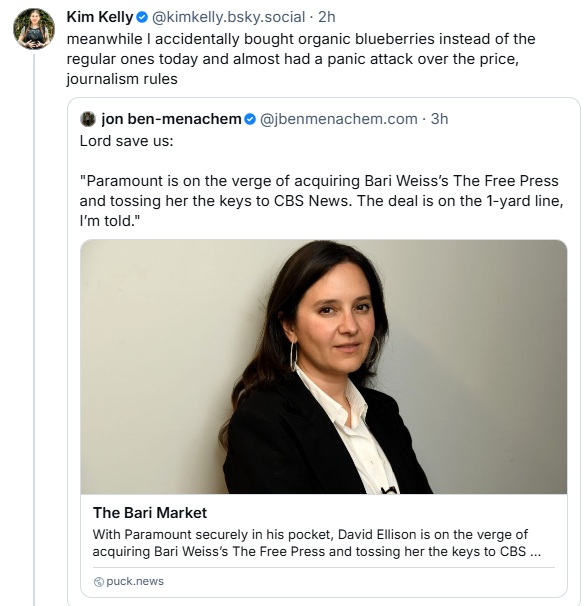
ODDS AND SODS
* YouTube TV will carry C-SPAN’s three channels on its base package starting this fall and has also agreed to sponsor the network’s coverage of America250 celebrations next year. I suspect the bad press that resulted from YouTube TV's recent decision to add the uber-right wing network OAN to its lineup helped make this deal possible. C-SPAN is also being added to the Hulu Live TV lineup, although it's not clear if that will include just the base C-SPAN channel or all three of its channels.
* Season seven of The Kelly Clarkson Show will premiere on Monday, September 29th.
* A day before the series premiere, Peacock has renewed The Paper for a second season.
* CNN will air the 40th anniversary of the Farm Aid music festival from 7 p.m. ET to midnight on Saturday, September 20th.
* Season five of Slow Horses will premiere Wednesday, September 24th on Apple TV+. Here is a first video look at the new season.
* The fourth and final season of Bel-Air will premiere Monday, November 24th on Peacock.
* Eight years after it aired a new episode, season twelve of Ice Road Truckers will be premiering Wednesday, October 1st on The History Channel.
* Acorn TV has ordered a third season of Signora Volpe, which will consist of three 90-minute episodes.
SUPPORT THE BACK INDIE MEDIA DRIVE
As I mentioned in an earlier email, Too Much TV is part of a September Back Indie Drive, in which 30+ independent publications are taking part. Each one is run by a creator-model journalist who’s building something sustainable, bold, and deeply needed in today’s fractured media environment.
Every day this month I am going to quickly highlight a publication from the campaign list and I hope you'll check them out. Supporting independent media has never been more important and there are truly some talented journalists on the list:
Subscribe for free here. Or you can can upgrade to a paid subscription at this link.
WHAT'S COMING TOMORROW
THURSDAY, SEPTEMBER 4TH:
All the Queen’s Men Season Four Finale (BET+)
Blood & Myth Series Premiere (Hulu)
Countdown: Canelo v Crawford (Netflix)
Fatal Lust (ALLBLK)
Lynley (BritBox)
NCIS: Tony & Ziva Series Premiere (Paramount+)
Pokémon Concierge (Netflix)
The Paper Series Premiere (Peacock)
FRIDAY, SEPTEMBER 5TH:
* Dish It Out Series Premiere (Prime Video)
* Highest 2 Lowest (Apple TV+)
* Love Con Revenge (Netflix)
* Queen Mantis Series Premiere (Netflix)
* Rel Talk (Tubi)
* The Great British Baking Show Collection Thirteen (Netflix)
SEE YOU ON THURSDAY NIGHT!
Too Much TV: Should Most Streaming Original Movies Receive A Theatrical Release?
- Details
- By Rick Ellis
