
For the most part, stand-up comedy is a young man's game. Sure, you can keep doing it until you drop dead while at the mike at some random casino (which is likely the way Jay Leno will die). But like songwriting, great standup requires a focus and unhealthy competitive compulsion that is much easier to pull off at 22 than it is at 52.
However, staying relevant comedically also requires reinventing yourself to reflect both the changes in your life and the changes in society. Because comedians can go from super hot to unwatchable in a heartbeat. A problem that I think science describes as the "Andrew Dice Clay Syndrome." So finding a new schtick, having the discipline to write to the new persona and putting in the stage time to make it work...well, few comics are willing to make that level of effort.
Dave Chappelle is 52, and from what I can tell, over the past few years, he has reinvented himself as a bit of a comedy troll. He consistently says things he knows will upset some people and channels their anger into a self-righteous mocking that has become his preferred style of comedy. It's a reflection of that new persona that when I told people Chappelle had a new Netflix special, their first question was always "Did he do any trans jokes?"
I have no idea what Dave Chappelle really thinks of trans people. I know what he says about them and how much he revels in his ability to tell jokes that would damage someone else's career while riding the controversy to bigger successes. I half suspect it's all just a giant troll. Trans people are a useful foil for his humor and it builds on the reputation he tries to portray as being a "speaker of truth."
Dave Chappelle: The Unstoppable is a technical tour de force of stand-up comedy. His "closing bit" lasts more than half an hour, spanning more than a hundred years and touching on America's racism and the efforts of white to beat down any black man who dares to become too successful. And while he makes some good points, he does so by telling stories that range from slightly mistaken to so factually wrong that even Donald Trump would say, "Wow, I think that's a bit much."
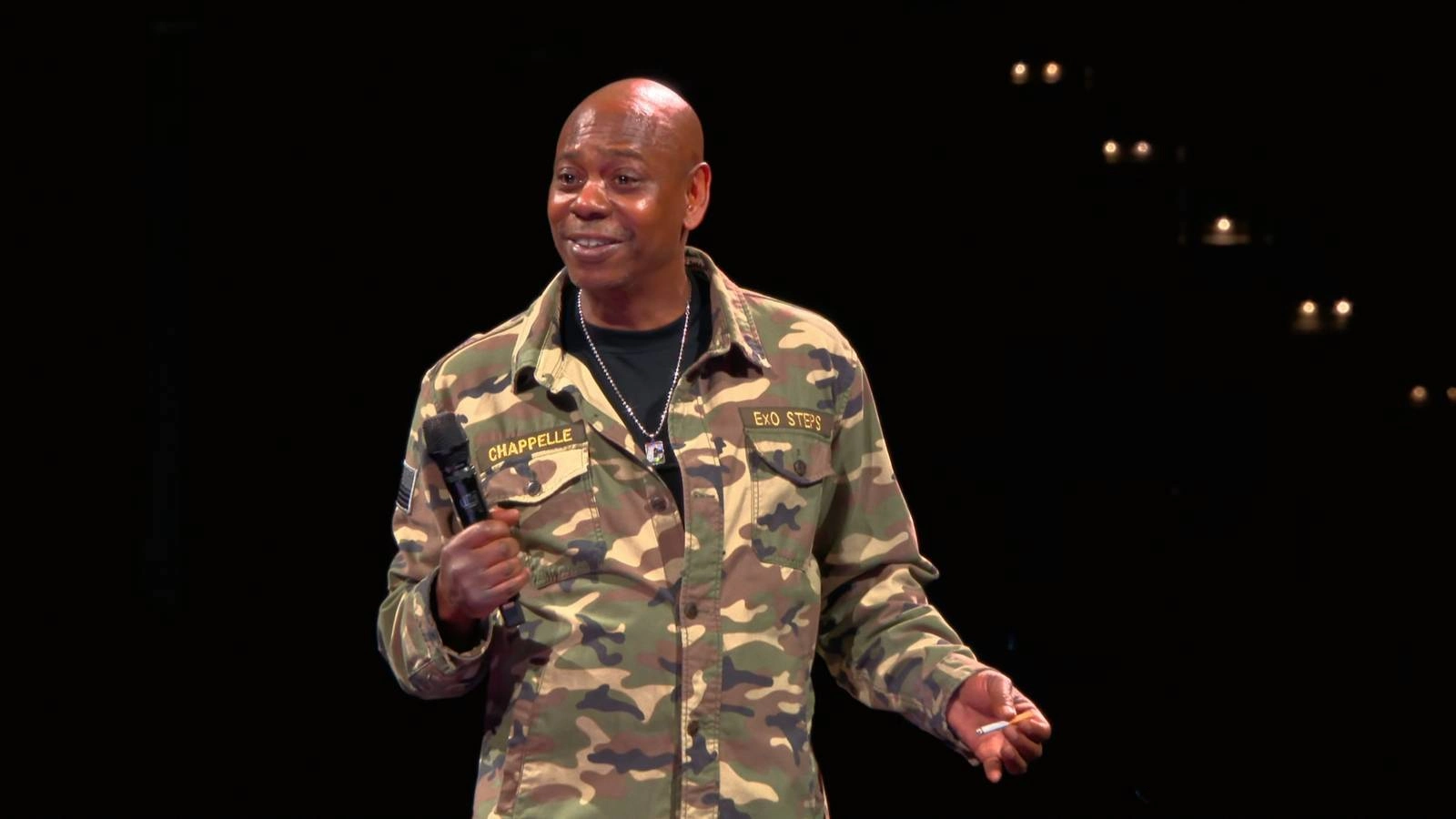
Wearing a Colin Kaepernick camo jacket, Chappelle takes the stage and opens with complaints about Donald Trump and the crackdowns that have come to various cities, including his hometown of Washington D.C. It's maybe a bit surprising to hear that if you're one of those conservatives who celebrated Chappelle's anti-trans stance. But it seems to be a fairly honest assessment of how he feels.
He then works through an often funny and somewhat unpredictable series of bits, including a story in which he claims he killed a trans audience member with a falcon during a show in the Middle East. According to him, while he was found guilty, he walked away because, over there, killing a trans person is only a misdemeanor.
He talks a bit about why he performed at the controversial comedy festival in Saudi Arabia, and while he claims he did it because he felt freer to speak there, I also remember when he claimed he was moving to Ghana and opening a comedy club. So I'm not saying I don't believe him. But I do have a suspicion he did it for the money, but that reason isn't as entertaining. Or unstoppable.
At about the 33-minute mark of the special, Chappelle tells the audience that he wants to try something he has been working on, "the longest closer of my career." He says that he is going to do two closers: the new one and, if he has time, his closer from Saudi Arabia.
And he begins that 40-minute comedic tour-de-force, which opens with a thoughtful take on how he is feeling and how he thinks the audience is feeling in 2025:
"I know how people are feeling right now, and I hope that this brings you peace. I feel that way too. Without question. 1.000% without question. All of us, individually and collectively, are living through some sort of conspiracy, I'm sure. That feeling you have that something is wrong, or you might feel like, "Hey, am I right about this? Am I crazy?" No, nigga. No, you're not crazy."
"This thing you're feeling, I'm telling you, I feel it too. But here's what I suggest. If you don't know what the conspiracy is, then just say that. "I don't know" is an acceptable answer. In fact, if you don't know, it is the best answer. But all this fucking guessing out loud about what the conspiracy is, I'm begging you, please, shut the fuck up. You're going to make everybody sick that way. You can say "I feel," you can say "I think," or "I suspect," or "It looks to me like," but please, please stop saying you know. Because in times like this, the last person I trust is the nigga that's sure. This is madness."
And although Chappelle throws off the comment casually, he then tells the audience, "Here's what I think. Somehow this country went wrong..in 1910." That "here's what I think" comment was a subtle warning to the audience that what he is about to say may not be all that true.
He proceeds to tell the story of famed boxer Jack Johnson. He was the first black Heavyweight champion of the world. For decades, white boxers had refused to fight black boxers. But a Canadian champion gave Johnson a shot, and he proceeded to beat every white boxer that faced him.
His success enraged white fans so much that the phrase "Great White Hope" was coined to describe the search for a white boxer who could beat Johnson. And when Johnson beat that Great White Hope, there were nationwide riots that led to the deaths of a number of blacks.
All of this is true, and Chappelle tells the story deftly and entertainingly. But then he brings up Johnson's downfall, which was his conviction under the Mann Act for transporting a woman across state lines for sexual purposes. Without explicitly saying it, he suggests the law was passed just to punish Johnson. Which was not the case.
The Mann Act was originally called the White-Slave Traffic Act of 1910, and it was designed (albeit poorly) to crack down on the kidnapping and transporting of women to cities where prostitution was legal. But the law was so badly written that it essentially made even sex between consenting partners illegal, and that is how Johnson was convicted. But for that matter, so was Charlie Chaplin. The law was used against Johnson, but it wasn't written specifically to punish him.
As Chappelle tells this part of the story, he asks the audience to remember what he is saying later in the show. Why? Because he uses that "Mann Act was created to punish blacks" argument as a way to suggest Sean Combs was targeted the same way.
And Chappelle lies about Combs a few times during his set, including claiming that Combs tackled the man who rushed the stage during a Chappelle performance at the Hollywood Bowl. It was actually Jamie Foxx, although if stories at the time are true. Diddy's bodyguards did beat the crap out of him backstage. Why all the roundabout conspiratorial claims that Combs was somehow framed or beaten down by the white establishment? Well, you'll have to ask Chappelle about that one.
But the part of Chappelle's closer that is getting the most attention is also filled with the most historical inaccuracies, although it makes for a solid bit.
He talks about Stevie Wonder and how Wonder asked Chappelle to skip Aretha Franklin's funeral in Detroit so he could go to the Capitol, where Sen. John McCain was lying in state.
According to Chappelle, when the vote happened in the Senate to approve the Martin Luther King Jr. holiday, the vote was 99-1, with only McCain voting against it.
He goes on to claim that when McCain ran for President against Barack Obama, that vote came back to haunt him. And that McCain pushed through a pardon of Jack Johnson, which was sorta, kinda close to the truth. He unsuccessfully tried five times to get a Senate Resolution passed asking for the President to pardon him, and the request was denied twice under President Bush and three times under Barack Obama. Weirdly, the pardon was finally approved by President Trump.
So Chappelle wraps up the story by telling the audience that Stevie Wonder asked him to go to where McCain's body was lying in state, lean over the body, and say, "Uh, Stevie Wonder sent me. Goodbye, ni*ga."
And almost none of that is true. Yes, Aretha Franklin's funeral and McCain's lying in state did happen on the same day. But McCain wasn't the only vote against the MLK Holiday in the Senate. The final vote was 78-22, and McCain wasn't even a Senator. He was a Congressman at the time and voted against the bill. But he later came to regret the vote and gave a well-publicized speech in Memphis apologizing for his decision. And Wonder doesn't appear to have hated McCain. In fact, he said that he had come to respect John McCain because McCain “grew to know compassion was not about any political party. It was about loving people for just the way they are." So the open casket story seems...unbelievable?
So why tell this complex web of lies at all? I have no idea, although I suspect that this is all Chappelle's way of entertaining himself and showing just how easily people will believe stories that sound real, even if they don't stand up to the slightest scrutiny. And in fact, social media is filled with clips of that McCain story, with people taking the entire story at face value.
The problem with this approach is that it becomes hard to take anything he says seriously. He goes on to talk about his friendship with Nipsey Hussle and how the rapper was developing a documentary about the controversial Honduran herbalist Dr. Sebi (Alfredo Bowman) at the time of his death. He mentions the conspiracy theory that Hussle was killed because of the documentary, but even Sebi's family has discounted that story. Chappelle could have mentioned that Nick Cannon made a big deal years later of claiming he was completing the documentary, and even released a trailer about six years ago, but still hasn't released it and refuses to discuss why. Now THAT sounds like a conspiracy.
I've watched Dave Chappelle: The Unstoppable a few times now, and my takeaway is that while it's filled with actual jokes, it was primarily released as a low-key branding effort and trolling exercise. He wants to come off as fearless while at the same time yanking the chains of as many people as possible.
Which I suppose is entertaining. But it's a bit like watching Jimi Hendrix humping his guitar and then setting it on fire while he plays on. It's a creative choice, and maybe it's fun for the performer. However, it sure feels like a pointless distraction from the talent that lies underneath the flash.
Dave Chappelle: The Unstoppable is currently streaming on Netflix.