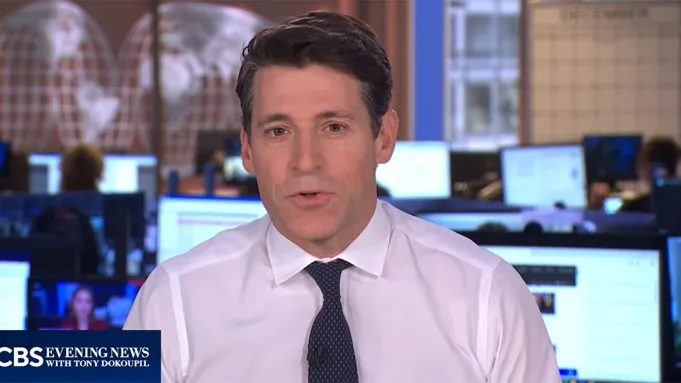
Earlier this week, the incoming CBS Evening News anchor Tony Dokoupil posted a video explaining his belief the audience for legacy news programs doesn't trust what they see because of inherent bias and an over-reliance on listening to experts instead of the "people."
"People don’t trust us like they used to. And it’s not just us. It’s all legacy media."
He then went on to talk about some of the topics he said people bring up to him when they discuss the media, and the list was more reminiscent of the grievances you'd hear on a conservative talk radio segment than a random collection of complaints about the mainstream news: "Russiagate," coverage of Hillary Clinton's emails, COVID lockdowns and Hunter Biden's laptop.
I have no idea of what is in Tony Dokoupil's heart when it comes to news or how much he is being guided by new CBS News Head Bari Weiss. But given that the thing most casual news viewers know about Tony Dokoupil is a 2024 interview where he questioned author Ta-Nehisi Coates about his work on race and reparations, with Dokoupil suggesting parts of Coates' writing could resemble extremist content without his accolades. While not quite using the phrase, he suggested Coates might be antisemitic. Having read the book, it seemed to me at the time to be an effort by Dokoupil to make some news by pushing back at an author who has faced a great deal of criticism from conservatives about his thoughts on race relations in the U.S.
Dokoupil was originally set to take over the CBS Evening News anchor chair on Monday, but that was pushed ahead to Saturday evening so he could anchor special coverage of the United States attack on Venezuela.
You can't judge any news program based on just one broadcast, but Saturday's show provides some hints from what might be on the way. Which is less about the direct partisanship guidance from Bari Weiss and more about the questions not asked. Which end up being a partisan decision in themselves.
The half hour broadcast opened with fairly mundane live shots from CBS News reporters in Palm Beach, Florida as well as the DHS headquarters in New York City. There wasn't much to work with, since no one had any real details about what had happened or what might come next.
But the bulk of the episode was an interview with United States Secretary of Defense War Pete Hegseth that covered two full segments, plus a final question in the final segment of the show. I've been told the interview was personally arranged by Weiss, which certainly sounds likely given her close connections to the Trump Administration.
And what did viewers learn? Man, President Trump is a forceful, determined man who "leaves nothing off the table." That has to be important, since Hegseth said variations of that sentiment multiple times. And that was about all he said.
Hegseth is an experienced media person and so it's not surprising that even when Dokoupil asked a question that meandered close to be uncomfortable, Hegseth simply did his patented shuffle off in an entirely different direction. He never directly answered a question he was asked by Dokoupil, and for whatever reason, Dokoupil never asked a follow-up question in hopes of getting some kind of clarity.
Dokoupil mentioned that some critics had compared the attack on Venezuela to the attacks on Iraq that ultimately led to the ill-fated Iraq War. Hegseth's primary response was to praise Trump's decision making powers, while stating that the attack on Venezuela was the "complete opposite" of what happened in Iraq. Which is at best, an unlikely characterization. Regardless, Dokoupil just moved on to the next question.
Contrast Dokoupil's gentle questioning of Hegseth with the more aggressive approach show by ABC News anchor George Stephanopoulos on Sunday when he did a one-on-one with Secretary of State Marco Rubio:
STEPHANOPOULOS: Trump said the US is going to 'run Venezuela.' Under what legal authority?
RUBIO: Well, first of all is that we have a quarantine on their oil. What that means is that their economy won't be able to move forward until the conditions that are in the national interest of the United States and the interests of the Venezuelan people are met. And that's what we intent to do. That leverage remains, that leverage is ongoing. And we expect that it is going to lead to results here. We hope it does. For the people of Venezuela, but most importantly, for us, for the interests of the United States.
We will hopefully have - hopefully - conditions so we no longer have in our hemisphere a Venezuela that serves as a crossroads for many of our adversaries around the world, including Iran and Hezbollah. A Venezuela that is no longer sending us gangs, is no longer sending us drug boats, is no longer a narco-trafficking paradise for all of those drugs coming out of Columbia and into the Caribbean and towards the United States.
And obviously, we want a better future for the people of Venezuela. We want them to have an oil industry where the wealth goes to the people. Not going to a handful of corrupt individuals and stolen by pirates all over the world. That's what we're working towards and we intend to use the leverage we have to achieve that.
STEPHANOPOULOS: Let me ask the question again -- what is the legal authority for the United States to be running Venezuela?
RUBIO: Well, I explained to you what our goals are and what the leverage we have to make it happen. As far as our legal authority is on the quarantine, it's very simple, we have court orders. We get orders from courts to go out and seize these sanctions. I don't know, is a court not a legal authority?
If Dokoupil's goal is to bring light to the situation and provide some context, then even the slightest follow-ups to Hegseth would have been helpful:
"Critics have noted that there is a lot of talk from Administration officials about Venezuelan oil paying for this invasion and sea quarantine. But that was the same rationale that was used by Bush Administration officials to justify the Iraq War. So how is this different?"
"You're saying that the United States isn't running Venezuela. But you also stress that the government has to do what the U.S. wants or there will be consequences. Isn't that essentially the same thing as running the country?"
"You mentioned that you intend to consult with members of Congress moving forward. But a number of members of the so-called "Gang Of 8" have told reporters they recently asked you directly if military action in Venezuela was being considered and you directly told them no. So how do you reconcile those two conflicting approaches? How can Congress trust your consultations if you haven't been honest with them in the past?"
Instead, Dokoupil spent maybe 15 minutes asking Hegseth a series of mild questions he refused to answer. And the only suggestion in the entire newscast that there might be some relevant questions to be raised with the Administration was in his final comments, in which Dokoupil mentioned some topics that are likely to come up in future weeks, such as the legal authority for the raids and the impact an increase of Venezuelan oil might have on U.S. gas prices.
As I said at the top of this piece, you shouldn't read too much into any one newscast. But Saturday debut by Dokoupil did not fill me with any great confidence he will somehow be able or willing to rise above the editorial challenges he'll face in a Bari Weiss news culture.
Review: 'The CBS Evening News With Tony Dokoupil'
- Details
- By Rick Ellis